
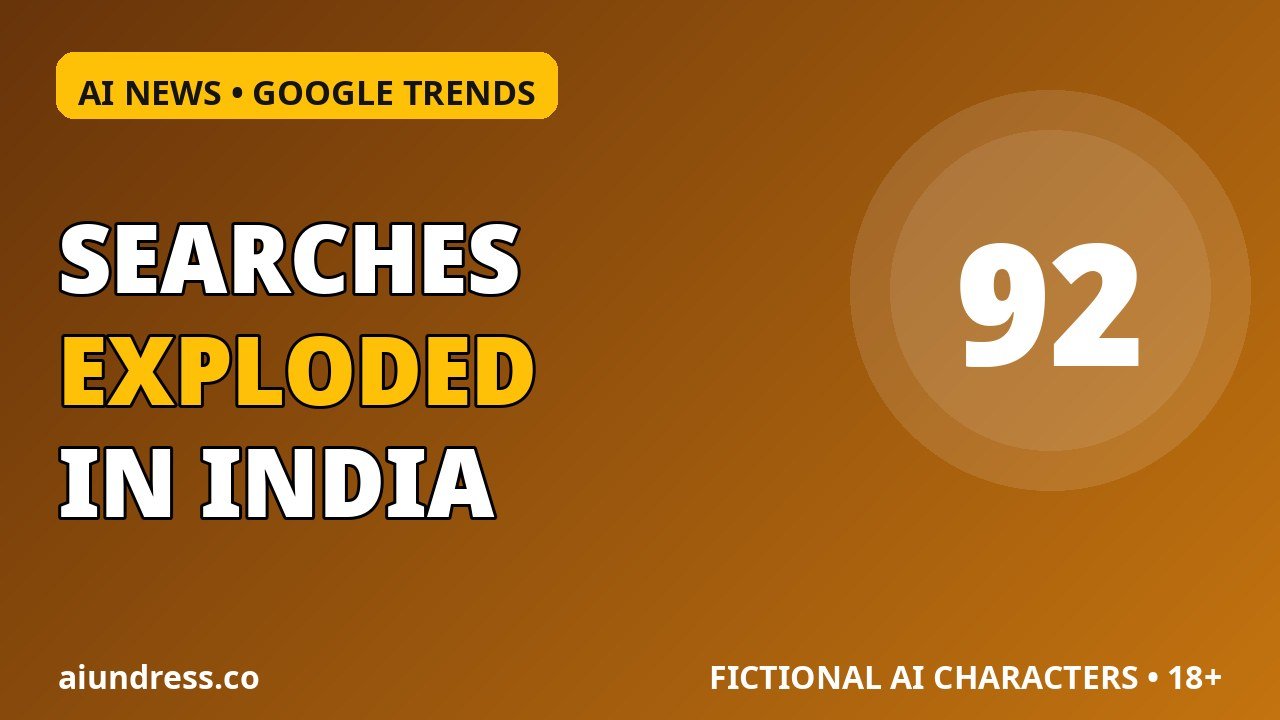
For three months, almost nobody searched it. Then came one week in November.
We pulled the Google Trends data for India ourselves this week — the last three months, term by term — and one line on the chart refused to behave. “AI video generator” did what it always does: stayed on top, day after day. “AI image generator” held its usual second place. And “ai girlfriend,” which had spent August, September and October drifting along the bottom of the chart, suddenly shot up in the second week of November to levels it had not touched in the entire period.
Here is what the data actually shows, what it does not, and why it matters if you create or market anything in the AI companion space.

The spike, in numbers
Google Trends scores are relative — 100 is the peak popularity for the terms compared, not a search count — but within that frame, the jump is dramatic. Through most of the past three months, “ai girlfriend” scored in the low single digits in India, essentially flat against the giant that is “ai video generator” (which averaged about 75 across the period and owns the chart).
Then the November window: the term leapt to the 50s, then the 70s, peaking around 92 before easing back. “AI companion,” its more polite cousin, rose at the same time from a flat zero-ish line to small but real numbers. Two related terms moving together, in the same days, is the signature of a genuine wave of curiosity rather than a data glitch.

After the peak, scores fell back toward their usual range — which is exactly what a spike looks like. The question is never whether a spike falls; it is what it leaves behind.
Why this keeps happening
This is not the first time. Industry statistics have tracked “AI girlfriend” searches growing by thousands of percent since 2022, setting new highs year after year. The pattern underneath is consistent, and three drivers explain most of it:
Moments, not marketing. Spikes usually trace back to something cultural — a viral post, a celebrity story, a widely shared video — that sends a large audience to Google at once to ask the same question: what is this, and how does it work? The search is curiosity first; sign-ups come later.
Loneliness economics. Every serious analysis of the companion market lands in the same place: a large, quiet audience — disproportionately young, urban and online late at night — is looking for conversation, attention and a presence that is always available. India, with its enormous young internet population, sits at the centre of that map.
Better characters. The companions of 2026 are not the scripted chatbots of a few years ago. Custom personas, memory, consistent faces and voices turned a novelty into something people describe, increasingly, as a relationship — and every improvement restarts the curiosity cycle for a new audience.
What the spike does NOT mean
Honesty about data is what separates analysis from hype, so three cautions. First, a Trends score of 92 is not 92 of anything absolute — it is relative to the other terms in the same chart, where “ai video generator” still dominates overall. Second, search interest is not purchase intent; most of that November wave was looking, not buying. Third, one week is not a trend line — the durable story is the multi-year climb in the statistics, with spikes as the punctuation, not the sentence.
What creators and site owners should take from it
If you publish in this space, the playbook writes itself. Be present before the spike: the pages that catch a curiosity wave are the ones already indexed when it hits — the honest comparisons, the how-tos, the explainers. Answer the spike’s actual question: the searcher wants to know what an AI girlfriend is, whether it is safe, what it costs and how to make one — content that answers plainly wins the click over content that oversells. And build for the day after: a visitor who arrives curious and leaves informed is worth ten who arrive curious and leave suspicious.
The November spike has already faded from the chart. The audience it revealed has not gone anywhere — and based on three years of data, it will be back, larger, asking the same questions. The only real choice is whether your page is the one that answers them.
For the practical follow-on, read our guide to creating an AI girlfriend character from scratch — fictional, consistent and yours.
A quick word on reading Trends data honestly
Because this story is built on a chart, it is worth saying how we read it — the same way you should read any “searches exploded” headline. Trends compares terms against each other inside one chart, region and time window; change any of those and the numbers change with it. A spike means relative attention jumped — real and newsworthy — but it must be weighed against the baseline. Here, the baseline matters: against “ai video generator,” the biggest term in this industry, “ai girlfriend” is normally a rounding error. For one November week, it nearly touched its rival’s everyday level. That is the accurate version of the story, and it is interesting enough without exaggeration.
It also explains the strategy behind this site’s own coverage. We write for the searches that are durable — video generators, image generators, character tools — and we publish the spike stories when the data genuinely moves, clearly labelled as spikes. Readers can tell the difference between reporting and hype, and so, in our experience, can Google.
Create Your Own Fictional AI Character — 18+ Only
SoulGen AI — Create a realistic or anime fictional character from a simple text description, edit her with prompts, and reuse the same character again. Try SoulGen AI →
Seduced AI — Build reusable fictional characters and turn them into images and short videos, with more models and scene controls. Try Seduced AI →
Affiliate disclosure: We may earn a commission if you sign up through these links, at no extra cost to you. 18+ only. Create only fictional adults, or adults who have clearly given you permission. Never upload or edit a real person’s photo without their consent.